Finding the Saddle Point: What Amul and Mother Dairy Can Teach Us About Game Theory and Strategic Pricing
Two competing dairy brands. One essential product. Similar pricing decisions. Is it merely a coincidence, or does game theory help us understand the strategy behind it?
Introduction: When Competition Becomes a Strategic Game
Imagine walking into a grocery store to purchase your daily milk. You have two familiar brands to choose from: Amul and Mother Dairy. Both are established players in India’s dairy market, and both compete for consumer preference through pricing, product quality, distribution and brand trust.
Now consider an interesting development.
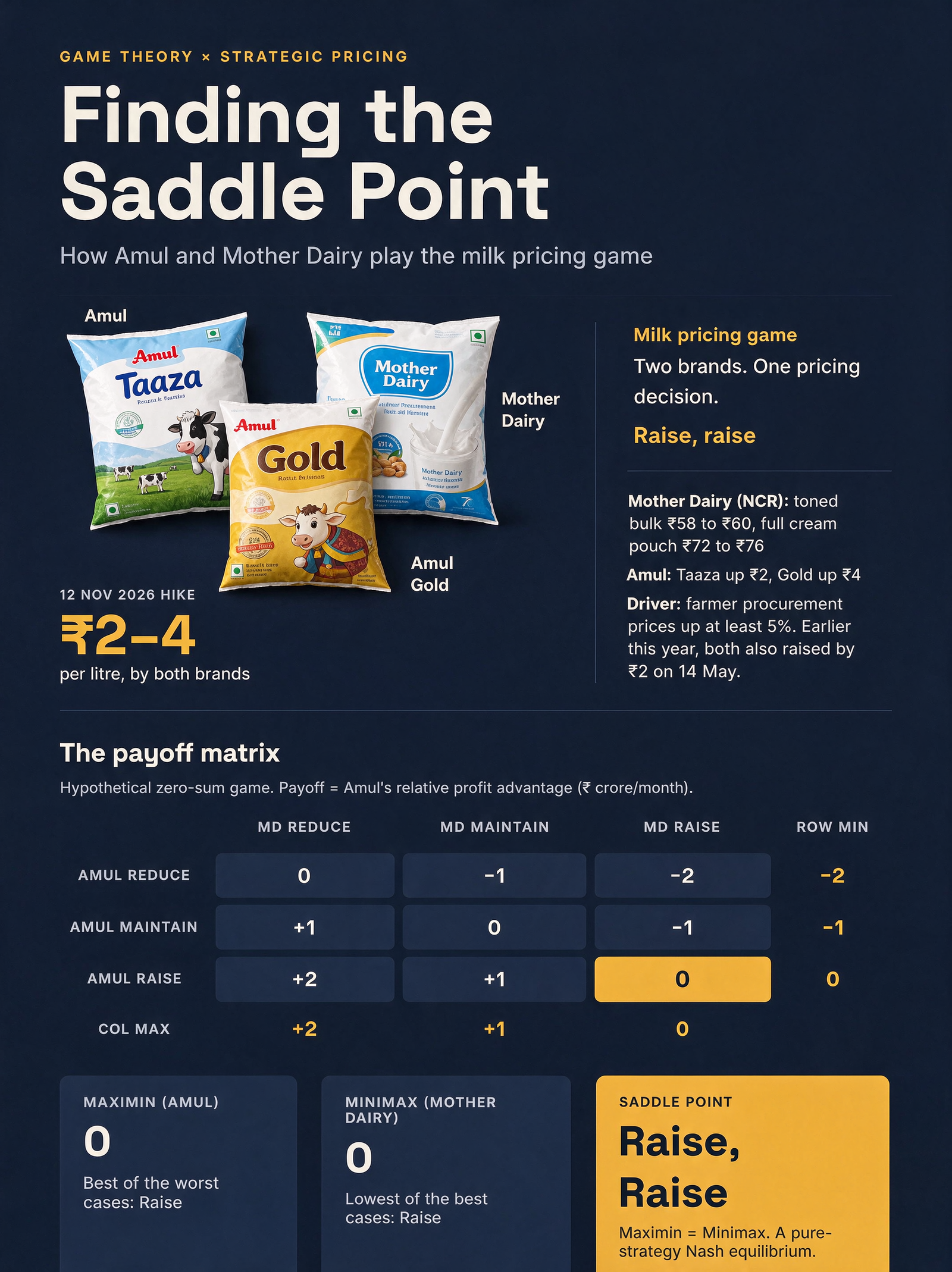
On November 12, 2026, Amul and Mother Dairy implemented milk price increases of approximately ₹2–₹4 per litre across several variants. Amul increased the price of its Taaza milk by ₹2 per litre and Gold milk by ₹4 per litre. Mother Dairy also revised prices across its liquid milk portfolio.
What makes this development interesting is not simply the increase in price, but the similarity in the timing of the decisions.
Does one company’s pricing decision influence the other? What happens when competitors know that their actions may trigger a response from the market? And can mathematics help us understand the possible outcome?
This is where Game Theory enters the discussion.
1. Understanding Game Theory: Thinking Beyond Your Own Decision
Game Theory is a mathematical framework used to study strategic decision-making between two or more participants, where the outcome for each participant depends not only on their own decisions but also on the decisions of others.
In simple words, it is about thinking one step ahead.
A business does not make every decision in isolation. Before changing its prices, launching a product or offering a discount, it must consider how competitors might respond.
For example, suppose Amul is considering increasing its milk prices. It must consider several possibilities:
- Mother Dairy might also increase its prices.
- Mother Dairy might maintain its existing prices to attract price-sensitive customers.
- Mother Dairy might reduce prices to gain a competitive advantage.
Similarly, Mother Dairy must consider Amul’s possible response before making its own decision.
This creates a strategic interdependence between competitors.
In economics, this type of market situation is particularly relevant to an oligopoly, where a relatively small number of significant firms compete in a market and each firm’s decisions can influence the others.
Game Theory helps us analyse these strategic choices systematically.
2. What Is a Saddle Point?
Now comes the central concept of this article.
A saddle point is a position in a two-person zero-sum game where the maximum of the row minima equals the minimum of the column maxima.
That definition may sound complicated, so let’s understand it in simpler language.
A saddle point represents a stable outcome in a payoff matrix where neither player can improve their position by independently changing their strategy, assuming the other player’s strategy remains unchanged.
To understand it, we need two important concepts:
A player looks at the minimum payoff associated with each available strategy and chooses the strategy that gives the best of these worst-case outcomes. In simple terms, it means choosing the best among the worst possibilities.
A player examines the maximum payoff the opponent could obtain under each available strategy and chooses the option that minimises that maximum. In simple terms, it means limiting the opponent’s best possible advantage.
When Maximin and Minimax are equal, a saddle point exists.
3. Applying Game Theory to Amul and Mother Dairy
Let’s construct a simplified hypothetical pricing game involving Amul and Mother Dairy.
Assume both brands have three strategic options:
- Reduce prices.
- Maintain existing prices.
- Increase prices.
For this model, the payoff represents Amul’s relative profit advantage over Mother Dairy, measured in hypothetical ₹ crore per month. A positive payoff indicates an advantage for Amul, while a negative payoff indicates an advantage for Mother Dairy.
The following payoff matrix is illustrative. It is not based on the companies’ actual financial statements or internal pricing data.
The Payoff Matrix
| Amul / Mother Dairy | Reduce | Maintain | Raise | Row Minimum |
|---|---|---|---|---|
| Amul: Reduce | 0 | -1 | -2 | -2 |
| Amul: Maintain | +1 | 0 | -1 | -1 |
| Amul: Raise | +2 | +1 | 0 | 0 |
| Column Maximum | +2 | +1 | 0 |
Source: Author’s hypothetical illustration. The highlighted cell is the saddle point.
Let’s understand what this matrix tells us.
Finding the Maximin Value (Amul’s Perspective)
Amul examines the minimum payoff in each row.
- Reduce: Minimum payoff = -2
- Maintain: Minimum payoff = -1
- Raise: Minimum payoff = 0
Now, Amul selects the highest among these minimum values.
This means that under this illustrative model, raising prices provides Amul with the best worst-case outcome.
Finding the Minimax Value (Mother Dairy’s Perspective)
Mother Dairy aims to minimise Amul’s maximum possible advantage. It examines the maximum payoff in each column.
- Reduce: Maximum payoff = +2
- Maintain: Maximum payoff = +1
- Raise: Maximum payoff = 0
This means that Mother Dairy’s strategy of raising prices minimises Amul’s maximum possible relative advantage in this particular model.
Identifying the Saddle Point
Now compare the two values: Maximin = 0 and Minimax = 0. Since both values are equal:
We have identified a saddle point at the intersection of:
This is the saddle point in our hypothetical pricing game.
4. What Does This Result Actually Mean?
The result suggests that, under the assumptions of our model, both brands increasing their prices represents a stable strategic outcome.
Neither player has an incentive to change its strategy unilaterally if the other continues to raise prices.
In game-theory terminology, this is a pure-strategy equilibrium in the constructed zero-sum game.
However, there is an important distinction. A mathematical model does not establish that Amul and Mother Dairy actually used this reasoning when making their pricing decisions. Their real-world decisions may have been influenced by several common factors, including:
- Rising cattle feed and fodder costs.
- Higher milk procurement prices paid to farmers.
- Increased packaging expenses.
- Transportation and distribution costs.
- Inflationary pressures across the dairy supply chain.
Both brands have publicly cited increased input and operational costs as reasons for their November 2026 price revisions.
Therefore, similar pricing decisions can emerge from similar market conditions without requiring any agreement or coordination between competitors.
5. The Bigger Business Lesson: Competition Is About Anticipating Reactions
One of the most important lessons from Game Theory is that a business must consider not only what it wants to do but also what its competitors might do in response.
Consider a different situation. Suppose Amul increases its prices while Mother Dairy maintains its existing prices. Mother Dairy could potentially attract price-sensitive customers. On the other hand, if Mother Dairy increases its prices while Amul maintains its prices, Amul could potentially gain a competitive advantage.
But when both increase their prices, the relative price gap may remain similar, depending on the specific products and the size of the increases.
This illustrates the importance of strategic interdependence in an oligopolistic market.
For businesses, the objective is not always to become the cheapest player. Sometimes, maintaining profitability, protecting market share, managing input costs and sustaining customer loyalty become equally important.
That is why pricing is not merely an accounting decision. It is a strategic management decision.
6. A Critical Perspective: Is the Real Dairy Market a Zero-Sum Game?
There is one more important economic distinction worth understanding.
Our payoff matrix assumes a zero-sum game, meaning that one player’s relative gain is treated as the other player’s relative loss. However, the actual dairy market is not necessarily a zero-sum game.
Amul and Mother Dairy can both experience higher costs, both increase prices and both potentially maintain their profitability. Their actual profits do not have to move in opposite directions.
Furthermore, consumers, farmers, distributors and retailers are also important stakeholders in the dairy ecosystem.
Therefore, the zero-sum matrix should be understood as a simplified analytical model for examining relative competitive advantage, not as a complete representation of the dairy industry’s economics.
This distinction is important because a good business analysis must recognise the limitations of the model it uses.
Conclusion: Every Pricing Decision Has a Strategic Side
The Amul and Mother Dairy example offers an interesting way to understand how Game Theory can be applied to business decisions.
A simple pricing decision can involve competitor reactions, cost structures, customer behaviour and long-term market positioning.
The saddle point helps us identify a stable outcome in a mathematical payoff matrix, while the concepts of Maximin and Minimax provide a structured way to evaluate strategic choices under uncertainty.
The larger lesson is simple:
In a competitive market, the smartest decision is not always the one that looks best in isolation. It is the one that also considers how others are likely to respond.
And that is precisely what makes Game Theory an important tool in modern business strategy.
— An MBA Perspective on Game Theory, Competitive Rivalry and Strategic Pricing